Can you detox from alcohol at home? For some people, yes, with medical support. For others it is genuinely dangerous, and the difference is not something to guess at.
Alcohol home detox is safe only for people with mild dependence, no history of seizures or severe withdrawal, and proper medical oversight from a GP or alcohol service. For anyone with heavier dependence, stopping suddenly at home can cause seizures and life-threatening complications. A short assessment is how you find out which group you are in.
This guide explains both paths honestly. We run medically supervised detox at our residential centres, but plenty of people who contact us do not need residential care, and we tell them so.
Most withdrawal is unpleasant but not dangerous. Alcohol is one of the exceptions.
If your body is dependent, alcohol has been suppressing your nervous system for months or years. Remove it suddenly and the system rebounds: anxiety, sweating, shaking, nausea, a racing heart, and in more severe cases hallucinations, confusion and seizures.
The NHS is blunt about this: it can be very dangerous to stop drinking suddenly if you are dependent on alcohol, and you should get medical help before you try (NHS, Alcohol-use disorder, 2026).
Withdrawal symptoms typically begin 6 to 12 hours after your last drink and usually last 3 to 7 days. The riskiest window for seizures and severe complications sits inside the first 72 hours, which is precisely when a person detoxing alone is least able to judge their own condition.
Supervised home detox is a genuine clinical option, and the NHS itself provides medical help for withdrawal either at home or in hospital. It is generally suitable when all of the following are true:
Notice what is not on that list: a home detox kit bought online, or willpower. Unsupervised cold turkey is the version that puts people in A&E.
If you are unsure how dependent you are, our drinking self-assessment quiz is a useful starting point, followed by a conversation with a professional.
Home detox is the wrong choice, full stop, if any of these apply:
For this group, medically supervised detox is not a luxury. It is the difference between a managed withdrawal and a medical emergency.
Call 999 or go to A&E if you or someone else has severe withdrawal symptoms after stopping: visible shaking, unusual confusion, seeing or hearing things that are not there, or a seizure. Do not drive yourself; the NHS advice is to call an ambulance.
For anyone dependent on alcohol, a gradual, medically guided reduction is safer than stopping suddenly. Cold turkey carries the highest risk of seizures and severe withdrawal. A supervised taper or a medical detox with prescribed medication manages the same process safely. Do not design your own taper; the right pace depends on your level of dependence.
Tapering sounds simple, but self-managed tapers fail for an obvious reason: the person managing the supply is the person with the dependence.
That is not a character flaw. It is how dependence works, and it is why the successful version of weaning off involves someone else holding the plan.
Physical withdrawal usually takes 3 to 7 days from your last drink, with symptoms starting within 6 to 12 hours and peaking in the first 72. Some symptoms, like disturbed sleep and anxiety, can continue for weeks or months after heavy long-term drinking. Detox clears the alcohol; it does not treat the addiction that caused it.
There is no way to meaningfully speed this up. Your liver processes alcohol at its own fixed rate, and no drink, supplement or sweat session changes it.
What actually helps during the process is unglamorous: fluids, regular food when your appetite returns, rest, and medical oversight of the symptoms that need it.
Cravings outlast detox, and this is where most unsupported attempts unravel. Three things have real evidence behind them.
Medication is one. The NHS lists acamprosate and naltrexone, which reduce cravings, and disulfiram, which causes unpleasant effects if you drink; these are prescribed once you have stopped, not during withdrawal.
Structured support is the second: therapy that addresses why you drink, whether that is CBT, counselling or a full residential programme. Peer support like AA and SMART Recovery is the third, and both are free.
The pattern across all three: nobody white-knuckles their way to lasting recovery on willpower alone. Build support in before the craving arrives, not after.
If your assessment points to residential detox, here is what that actually means at our Luton centre, rather than in the abstract.
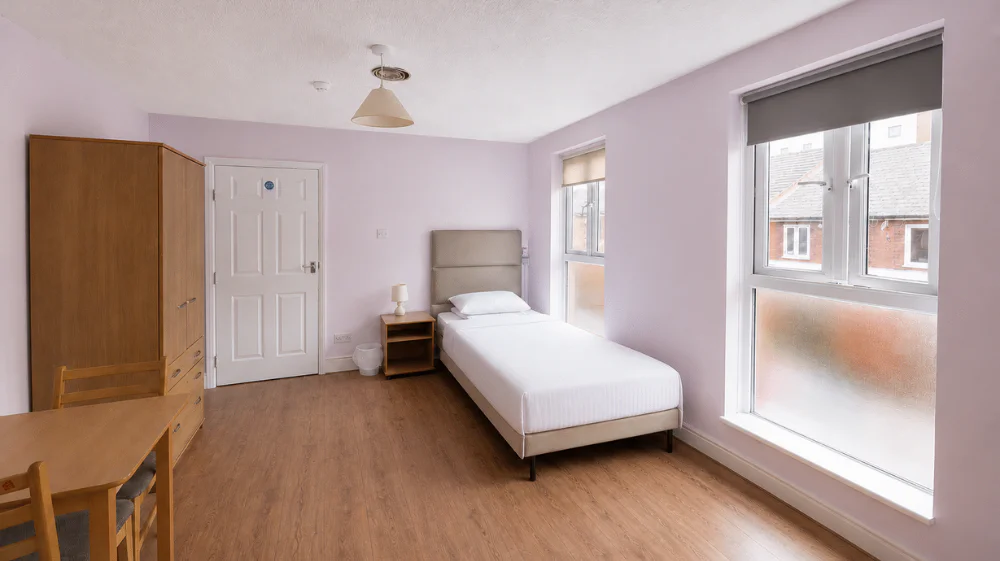
You are in one of 13 dedicated detox beds, with 5 rooms built for higher-intensity monitoring where it is needed. Staff are on 24 hours a day, and medication is available on-site through our Home Office Stock Licence, so withdrawal symptoms are managed as they appear, not after a pharmacy run.
Our doctors, led by physicians with specialist substance misuse experience, set and adjust your detox plan daily. When detox ends, therapy starts the same week: one-to-one counselling, group work, CBT and 12 Step facilitation, so the addiction gets treated, not just the withdrawal.
Treatment costs £4,250 a week with a two-week minimum stay at £8,500, everything included. Our full guide to what rehab costs in the UK breaks down how that compares across the market.
Admission can be arranged within 24 hours. Call 08000 380 480, any time, for a free confidential assessment; if home detox with your GP is the safer, cheaper, right answer for you, that is what we will say.
For those whose assessment supports a home detox, five rules keep it safe:
If you are weighing this decision right now, call us on 08000 380 480. The assessment is free and confidential, and it will tell you which path is safe for you.
Can I detox from alcohol at home safely?
Yes, if your dependence is mild, a clinician has assessed you, medication is prescribed where needed, and someone stays with you throughout. Unsupervised cold turkey is not safe for anyone who is physically dependent, because withdrawal can escalate to seizures within the first 72 hours.
How long does alcohol home detox take?
Physical withdrawal usually lasts 3 to 7 days, with symptoms starting 6 to 12 hours after the last drink. Supervised home detox programmes typically run 7 to 10 days including assessment and follow-up. Sleep problems and anxiety can persist for weeks after heavy long-term drinking.
What is the safest way to stop drinking?
Get assessed before you stop. For mild dependence, a GP-supervised reduction or home detox is usually safe. For moderate to severe dependence, medically supervised residential detox is the safest route, with 24-hour clinical cover through the highest-risk days.
What medication is used for alcohol detox?
During withdrawal, clinicians typically prescribe a reducing course of medication to prevent seizures and manage symptoms, alongside vitamin support. After detox, the NHS lists acamprosate and naltrexone to reduce cravings, and disulfiram to deter drinking. All of these require prescription and monitoring.
When is residential detox worth it?
When dependence is moderate to severe, when previous attempts to stop have failed, or when withdrawal history includes seizures or hallucinations. Residential detox provides 24-hour medical cover during the dangerous window and moves straight into therapy, which is what makes recovery stick.
| Cookie | Duration | Description |
|---|---|---|
| cookielawinfo-checkbox-analytics | 11 months | This cookie is set by GDPR Cookie Consent plugin. The cookie is used to store the user consent for the cookies in the category "Analytics". |
| cookielawinfo-checkbox-functional | 11 months | The cookie is set by GDPR cookie consent to record the user consent for the cookies in the category "Functional". |
| cookielawinfo-checkbox-necessary | 11 months | This cookie is set by GDPR Cookie Consent plugin. The cookies is used to store the user consent for the cookies in the category "Necessary". |
| cookielawinfo-checkbox-others | 11 months | This cookie is set by GDPR Cookie Consent plugin. The cookie is used to store the user consent for the cookies in the category "Other. |
| cookielawinfo-checkbox-performance | 11 months | This cookie is set by GDPR Cookie Consent plugin. The cookie is used to store the user consent for the cookies in the category "Performance". |
| viewed_cookie_policy | 11 months | The cookie is set by the GDPR Cookie Consent plugin and is used to store whether or not user has consented to the use of cookies. It does not store any personal data. |