
Alcohol continues to have a significant impact on public health across the UK. In 2024, 9,809 alcohol-specific deaths were registered, while more than one million alcohol-related hospital admissions were recorded in England during 2023/24.
This page brings together the latest UK alcohol statistics on deaths, hospital admissions, drinking patterns, dependence and treatment. Figures are drawn from official sources, including the ONS, NHS England and OHID, and are reviewed following each major data release.
The latest UK alcohol statistics highlight the scale of alcohol misuse, its health impacts and treatment needs:
9,809 alcohol-specific deaths were recorded in 2024, averaging 27 per day (ONS).
Alcohol-related deaths fell by 6.3% from 2023 but remained around 30% higher than in 2019.
Men were twice as likely to die from alcohol-specific causes as women (20.2 vs 9.7 deaths per 100,000).
Northern Ireland had the highest death rate at 21.4 per 100,000, followed by Scotland at 20.9.
Over 1 million alcohol-related hospital admissions were recorded in England in 2023/24 using the broad measure.
608,000 adults in England were estimated to be alcohol dependent in 2019/20.
329,646 adults accessed drug and alcohol treatment services in England in 2024/25, including around 100,000 receiving treatment for alcohol alone.
21% of adults in England drank more than the recommended 14 units weekly in 2024.
Around 1 in 5 UK adults do not drink alcohol, with abstinence more common among younger generations.
Sources: ONS, NHS England, OHID, House of Commons Library and UK public health agencies.
Using these statistics? You are welcome to cite this page. Please credit “Rehab Today PCP” with a link, and credit the primary source shown next to each figure (ONS, OHID, NHS England). Figures were last verified in October 2026. For press enquiries, contact us via the details on our contact page.
This section examines alcohol-specific mortality trends, with breakdowns by sex, age and UK nation, using ONS data. Understanding how many deaths occur helps quantify the scale of alcohol harm across the population.
There were 9,809 deaths from alcohol-specific causes registered in the UK in 2024, equivalent to 14.8 deaths per 100,000 people. That is 664 fewer deaths than 2023, a 6.3% decrease, and the first year-on-year fall since 2018.
The fall is genuinely good news, and worth keeping in proportion. Deaths remain around 30% higher than in 2019, and because alcohol-related disease is largely chronic, today’s figures reflect drinking patterns from years past.
| Year | UK deaths | Rate per 100,000 |
|---|---|---|
| 2012 | 7,402 | 11.6 |
| 2019 | 7,565 | 11.8 |
| 2020 | 8,974 | 14.0 |
| 2022 | 10,048 | 16.6 (record rate) |
| 2023 | 10,473 | 15.9 (record count) |
| 2024 | 9,809 | 14.8 |
Rates were stable through the 2010s, rose sharply from 2020, peaked in 2022–23, and have now fallen back to the lowest level since 2020 while remaining well above pre-pandemic norms.
2024 death rates by UK nation (age-standardised, per 100,000):
| Nation | Rate 2024 | Direction vs 2023 |
|---|---|---|
| Northern Ireland | 21.4 | Up, a record high |
| Scotland | 20.9 | Down, lowest since 2019 (1,185 deaths, NRS) |
| Wales | 16.8 | Down |
| England | 13.8 | Down |
Northern Ireland was the only UK nation where the rate rose in 2024, reaching the highest level it has ever recorded. Scotland remains the second worst affected but recorded its lowest rate since 2019.
Approximately 75–76% of alcohol-specific deaths result from alcoholic liver disease, with the remainder attributed to mental and behavioural disorders due to alcohol, and acute alcohol poisoning.
Sex differences: The male alcohol-specific death rate in 2024 (20.2 per 100,000; 6,480 deaths) was around double the female rate (9.7 per 100,000; 3,329 deaths). This two-to-one ratio has held in every year on record.
Age distribution: Rates fell between ages 25 and 79 compared with 2023, but rose among those aged 80 and over. The heaviest burden still sits in the 50 to 64 age group, reflecting cumulative lifetime consumption rather than necessarily current heavy drinking.
The distinction between alcohol-specific conditions (direct cause) and alcohol-related conditions (partial attribution, including certain cancers and cardiovascular disease) is important: counting all alcohol-related deaths produces a substantially higher total than the figures above.
Hospital admissions data illustrate how drinking contributes to the healthcare burden across the UK.
Broad measure: Captures any admission where an alcohol-attributable condition appears in primary or secondary diagnosis, including injuries, mental health conditions and chronic diseases partially linked to alcohol.
Narrow measure: Counts admissions where the primary diagnosis is wholly attributable to alcohol, giving a more conservative estimate of direct health harm.
England 2023/24 figures:
Trend: Broad-measure admissions have risen over the last decade even as average consumption has fallen, with a noticeable step up after 2020.
UK nation comparison (2023/24):
| Nation | Admissions (broad) | Rate per 100,000 |
|---|---|---|
| England | ~1,018,986 | 1,824 |
| Scotland | ~32,301 | 548 |
| Wales | ~29,430 | 494 |
| Northern Ireland | Data varies | ~480 |
Note: definitions and coding practices differ between nations, affecting direct comparability.
Adults aged 55 and over account for a growing proportion of alcohol-related admissions, reflecting the ageing-drinker pattern and harmful habits established in earlier decades.
There were 329,646 adults in contact with drug and alcohol treatment services in England between April 2024 and March 2025, a 6% rise on the previous year. People treated for alcohol alone made up 30% of them, around 100,000 adults, the second largest substance group (OHID, adult substance misuse treatment statistics 2024 to 2025).
New treatment starts also rose. 169,542 adults entered treatment in 2024/25, up from 158,991 the year before and 137,749 two years ago.
Set against the estimated 608,000 alcohol-dependent adults in England, the roughly 100,000 in alcohol-only treatment confirm the long-standing treatment gap: most dependent drinkers are not in treatment in any given year.
The alcohol-only group also accounted for 28% of deaths that occurred during treatment, second only to opiates. Starting treatment late, often after years of dependence, is a large part of why. Our guide to what rehab costs in the UK covers the private route for those who cannot wait for funded places.
This section outlines how much alcohol UK adults consume, and how many meet thresholds for higher risk drinking or dependence.
Average consumption: UK adults consumed approximately 9–10 litres of pure alcohol per head per year in recent years, equivalent to roughly 18 units a week on average.
The UK Chief Medical Officers’ low risk guideline recommends no more than 14 units a week, spread over several days. In 2024, 76% of adults in England said they drink alcohol, and 21% drank more than 14 units a week (House of Commons Library, Statistics on alcohol: England, 2026).
Non-drinkers: Around 20% (1 in 5) of UK adults report not drinking alcohol. Abstention is highest among younger people, with 25% of 18–24 year olds now completely teetotal based on recent survey data.
| Category | Percentage of adults |
|---|---|
| Non-drinkers | ~20% |
| Within guidelines (≤14 units) | ~55–59% |
| Above guidelines (>14 units) | ~21% |
| Possible dependence (AUDIT 20+) | ~3% |
AUDIT-based prevalence: The Drinkaware Monitor and national health surveys categorise drinkers as low risk, increasing risk, higher risk and possible dependence. About 3% of UK adults score 20+ on AUDIT, indicating possible dependence.
Alcohol dependence estimate: Around 608,000 adults in England were alcohol dependent in 2019–20 (14 per 1,000 adults), the latest official estimate. This group spans multiple stages and types of alcoholism, and only a minority receive alcohol treatment in any given year, as the treatment section above shows.
Binge drinking: Using Health Survey for England definitions (8+ units in a single day for men, 6+ for women), a significant proportion of drinkers engage in heavy episodic drinking. Between 2016 and 2019, binge drinking prevalence rose from 29.8% to 33.6%, with a particularly sharp increase among women from 13.8% to 21.7%.
Alcohol use and alcohol harm are unevenly distributed across the population, with clear patterns by age, sex and deprivation.
Age patterns in consumption:
Age patterns in harm:
Sex differences in consumption:
Sex differences in harm:
The alcohol harm paradox: People in deprived areas report equal or lower average consumption but experience significantly higher rates of alcohol-related harm. This paradox has been documented by Public Health England and Alcohol Change UK.
Inequality figures:
Regional variation in alcohol harm exists across the UK nations and within England.
Alcohol-specific death rates per 100,000 (2024):
| Nation | Rate per 100,000 |
|---|---|
| Northern Ireland | 21.4 (record high) |
| Scotland | 20.9 |
| Wales | 16.8 |
| England | 13.8 |
Within England (2024): the North East had the highest regional death rate at 21.1 per 100,000, almost double London’s 10.9, the lowest. The gap tracks the deprivation gradient described above.
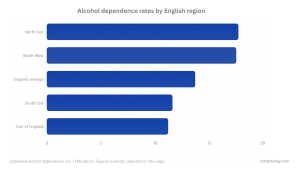
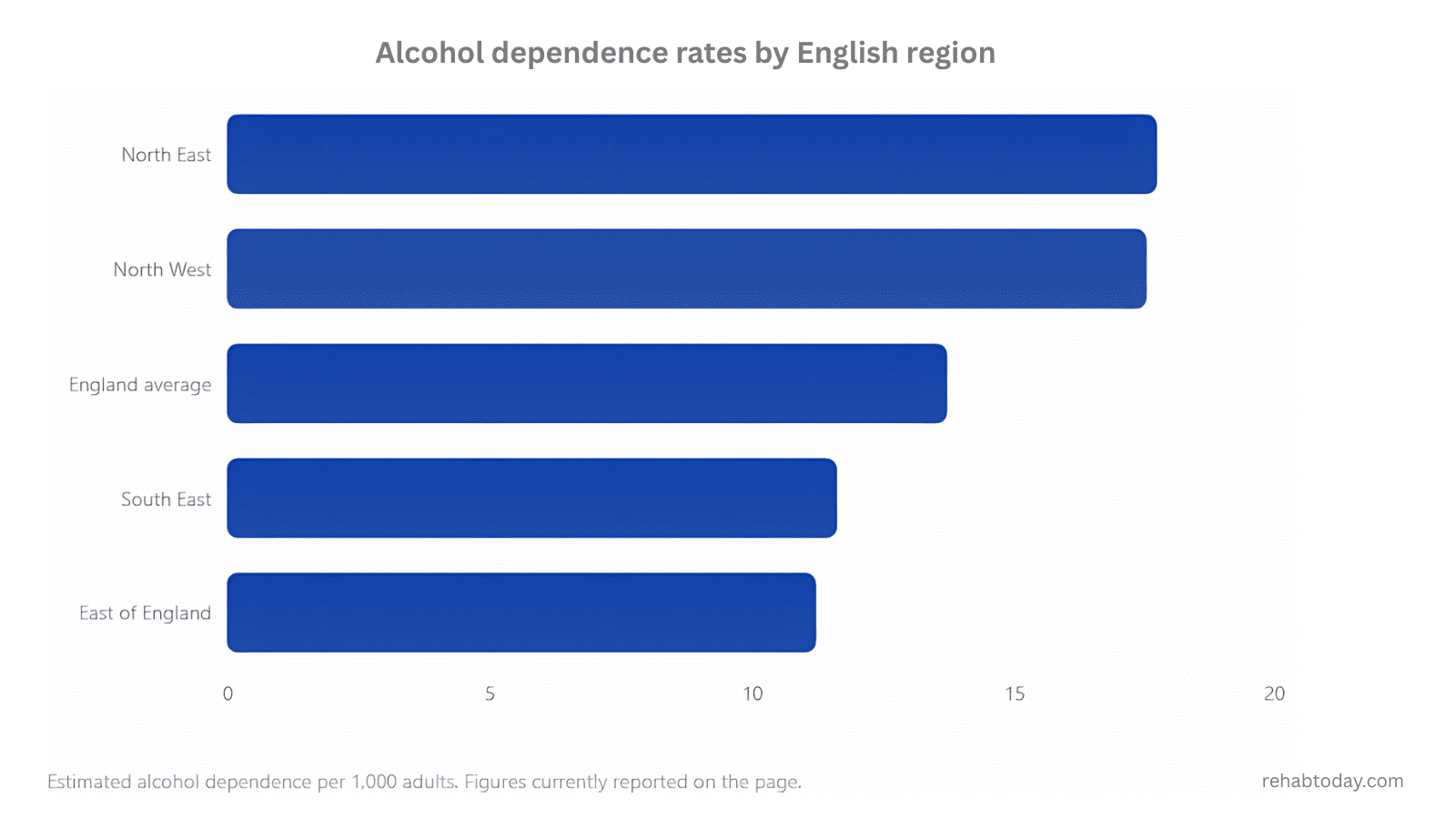
Regional dependence rates (LAPE data, per 1,000 adults):
| Region | Dependence per 1,000 |
|---|---|
| North East | 17.7 |
| North West | 17.5 |
| England average | 13.7 |
| South East | 11.6 |
| East of England | 11.2 |
Urban post-industrial areas typically show higher alcohol-specific mortality, while some rural areas show higher recorded consumption but lower acute harm.
Alongside health outcomes, alcohol produces measurable economic and social costs.
Headline economic cost: Approximately £35 billion per year in the UK, representing 1.3–2.7% of GDP (Public Health England evidence review).
Cost breakdown:
Alcohol-related violent crime: Around 440,000 alcohol-related violent incidents in England and Wales in 2023/24 (ONS Crime Survey), contributing to the use of interventions such as the alcohol abstinence tag for offenders.
Drink-drive collisions: Approximately 6,800 road casualties related to drink driving in 2022 across Great Britain (Department for Transport).
These metrics are used by policymakers and research bodies to quantify alcohol’s societal burden and set public health priorities.
This section helps readers interpret alcohol statistics correctly.
Registration vs occurrence: Mortality figures are based on the date a death was registered, not the date it occurred. For alcohol-specific deaths registered in 2024, the median registration delay was 10 days in England and 11 in Wales; of the 9,809 deaths registered in 2024, 85.5% occurred that year.
Under-reporting: Self-reported surveys typically underestimate consumption by 20–40% compared with alcohol duty clearance data.
ICD-10 coding: Hospital and mortality coding relies on ICD-10 classification. Choices about which codes count as alcohol-specific affect trend comparisons over time.
Broad vs narrow measures: Cross-country comparisons must account for different coding practices between the UK nations.
Model-based estimates: The 608,000 dependence figure combines survey data and service-use modelling, with a 95% confidence interval of roughly 501,000 to 767,000.
COVID-19 effects: Data from 2020–2023 may reflect pandemic-related changes in health service use and death registration.
Age-standardised rates: Rates are adjusted for population age structure (2013 European Standard Population), allowing fair comparison between areas and over time.
In 2024, 9,809 people died from alcohol-specific causes in the UK, around 27 deaths every day (ONS). This counts only deaths wholly caused by alcohol, such as alcoholic liver disease. Counting every death where alcohol contributed, such as certain cancers, produces a far higher total.
The latest official estimate puts alcohol dependence at around 608,000 adults in England alone (2019–20, OHID/PHE). Only a fraction are in treatment: roughly 100,000 adults received alcohol-only treatment in England in 2024/25.
Deaths tell a mixed story: 2024 saw the first fall in alcohol-specific deaths since 2018, but they remain about 30% above pre-pandemic levels. Consumption patterns are shifting rather than simply falling, with younger adults drinking less while harm concentrates in those aged 50 and over.
Northern Ireland recorded the UK’s highest alcohol-specific death rate in 2024 (21.4 per 100,000, a record high), narrowly ahead of Scotland (20.9). Within England, the North East (21.1) has roughly double London’s rate (10.9).
The most widely cited estimate is around £35 billion a year across healthcare, crime, lost productivity and social care (Public Health England evidence review). The NHS share alone runs to billions annually.
This section clarifies time coverage and sources to support data accuracy and transparency.
Reference years used throughout this article:
Principal UK data providers:
National surveys referenced: Health Survey for England, Scottish Health Survey, National Survey for Wales, and Drinkaware Monitor for AUDIT-based measures.
Last reviewed: October 2026 (next review after the next ONS mortality release)
Key terminology:
| Cookie | Duration | Description |
|---|---|---|
| cookielawinfo-checkbox-analytics | 11 months | This cookie is set by GDPR Cookie Consent plugin. The cookie is used to store the user consent for the cookies in the category "Analytics". |
| cookielawinfo-checkbox-functional | 11 months | The cookie is set by GDPR cookie consent to record the user consent for the cookies in the category "Functional". |
| cookielawinfo-checkbox-necessary | 11 months | This cookie is set by GDPR Cookie Consent plugin. The cookies is used to store the user consent for the cookies in the category "Necessary". |
| cookielawinfo-checkbox-others | 11 months | This cookie is set by GDPR Cookie Consent plugin. The cookie is used to store the user consent for the cookies in the category "Other. |
| cookielawinfo-checkbox-performance | 11 months | This cookie is set by GDPR Cookie Consent plugin. The cookie is used to store the user consent for the cookies in the category "Performance". |
| viewed_cookie_policy | 11 months | The cookie is set by the GDPR Cookie Consent plugin and is used to store whether or not user has consented to the use of cookies. It does not store any personal data. |